






Animations can change how a WordPress website feels. A simple page can become more engaging with smooth scroll effects, animated text, interactive elements, and other types of motion. In the past, creating these effects often meant writing custom JavaScript or hiring a developer.
Today, you will find many animation plugins in WordPress that make advanced effects much easier to build. But not every animation plugin offers the same features or performance. Some are great for simple entrance effects. Others focus on scroll-based animations, text effects, SVG motion, or interactive experiences.
In this guide, we will help you take a look at the best WordPress animation plugins and compare them based on animation features, page builder support, ease of use, performance, and pricing. Hope you enjoy it. Let’s get started!
Full disclosure: This post is published by the HappyAddons team at weDevs, and HappyAddons is included in this list. We have tried to keep the comparison fair and honest. We highlight the strengths of each plugin and include HappyAddons only where it genuinely fits the category.
What to Look for Before Choosing an Animation Plugin
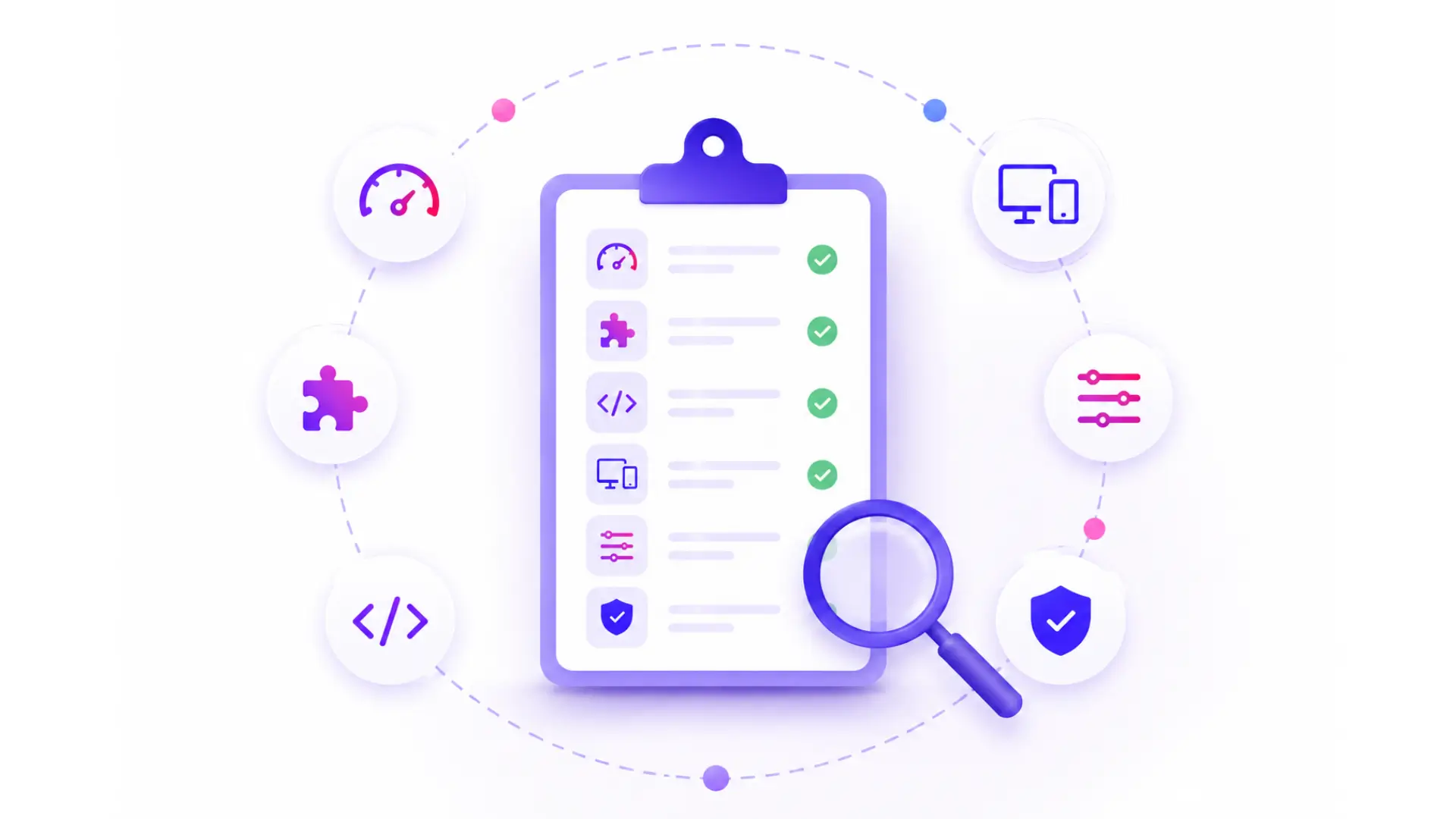
Before choosing a WordPress animation plugin, look beyond the number of effects it offers. The animation engine, performance, pricing, and page builder support can make a big difference. A plugin may have many effects but still fail to provide the type of animation you actually need. So, you must consider checking the following points when choosing an animation plugin.
a. Animation Engine
The animation engine decides what the plugin can actually do. Most WordPress animation plugins use either CSS animations or GSAP. CSS is lightweight, but it’s good only when you want to rely on basic animations like fading, sliding, and bouncing.
If you look for advanced animations like morphing, scroll-based triggers, pin effect, dropping effects, etc., you should definitely look for GSAP-based animation plugins.
b. How the Plugin Loads Its Assets
Performance should also be part of your decision. Check whether the plugin supports conditional asset loading. This means the plugin should load its animation assets only when needed. If you use an animation on one page, the plugin should not unnecessarily load all animation resources across your entire website.
Check the detailed comparison between Elementor and Divi.
c. Page Builder Compatibility
Your animation plugin must work properly with the page builder you use. For example, an Elementor user should check Elementor compatibility before choosing a plugin. Divi users should look for Divi support, while Gutenberg users should check whether the plugin works with the WordPress block editor.
d. Type of Animations You Need
Finally, think about what you actually want to create. A plugin that is great for simple entrance animations may not be suitable for advanced interactions. For basic websites, effects such as fade, slide, zoom, and bounce may be enough.
For more interactive websites, you may need scroll-triggered motion, pinning, horizontal scrolling, text animation, SVG effects, motion paths, or physics-based interactions.
Choose a plugin based on the type of experience you want to build, not simply the number of effects listed on its feature page.
Explore this post on how to create a clothing website with Elementor.
Best WordPress Animation Plugins Discussed in Detail
The theoretical part regarding WordPress animation plugins has been covered above. Now, in this section, we’ll list and discuss the best WordPress animation plugins, including what they are best for. Hope this will open up your insights. Keep reading!
1. HappyAddons (Best for Elementor)
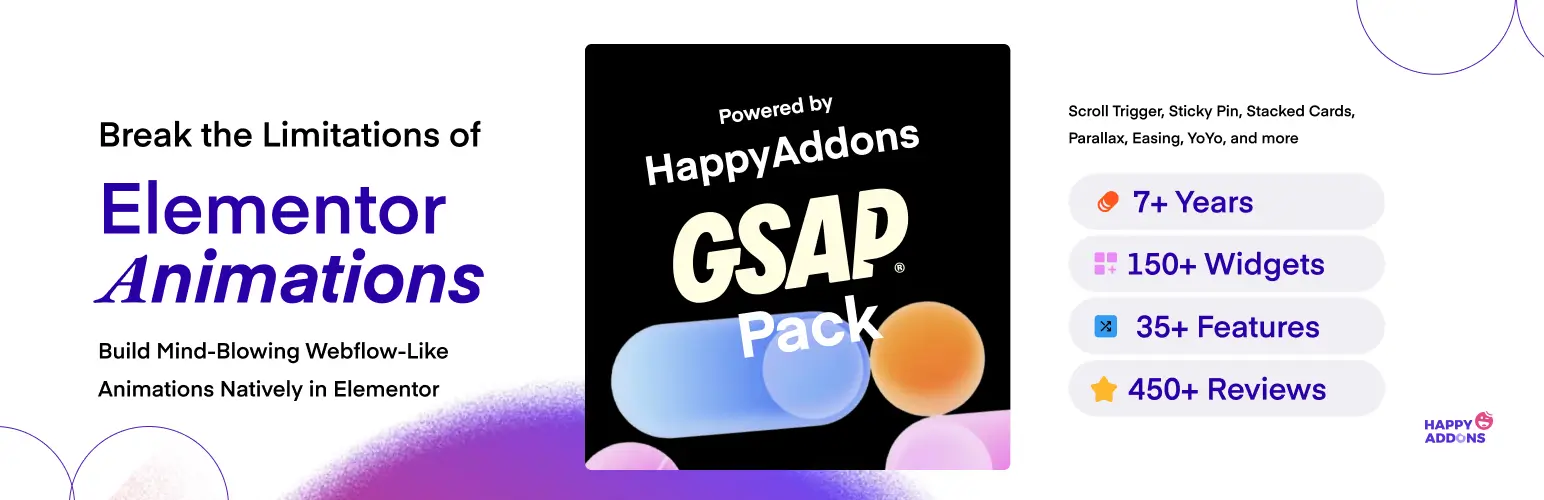
HappyAddons is a popular Elementor addon with 400,000+ active users. Its GSAP Pack adds a dedicated collection of advanced animation features and widgets to Elementor.
The pack includes Global Animation, which lets you apply GSAP animations to almost any Elementor element. You can create scroll-triggered animations, control animation progress with scrolling, and adjust properties such as position, scale, rotation, opacity, and more.
It also includes Sticky / Pin Element, Horizontal Scroll, Appearing Image Animation, Infinite Marquee, Image Trails, and Text Animation. These features help you create more interactive layouts without writing custom JavaScript.
The dedicated widgets add even more advanced effects. Dropping Elements brings physics-based movement with falling and bouncing objects. Stacked Cards creates card stacking effects on scroll. GSAP SVG Draw lets SVG paths draw themselves as visitors scroll through the page.
The pack also supports scrubbing, which connects the animation progress directly to the visitor’s scroll position. This allows animations to move forward and backwards as users scroll up and down. The plugin is actively working to come up with more GSAP-powered features and widgets in the next releases.
On top of that, other than GSAP, HappyAddons already has 150+ widgets and 35+ features by which you can build full-fledged landing pages, which is why it has been a popular plugin for many years. Once used GSAP with them, you can make the site lively, which is quite difficult to do with most other plugins.
Explore this tutorial on how to add Lottie animation in WordPress.
2. Animation Addons (Best for Elementor)
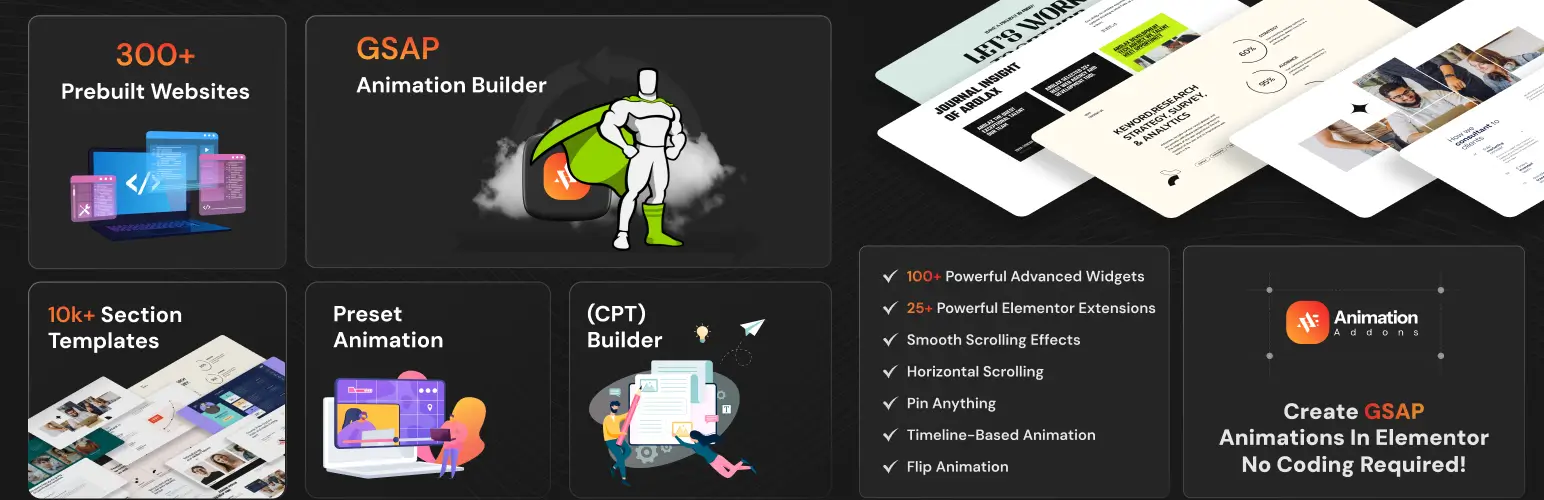
Animation Addons for Elementor is a strong choice for designers who want to build animated pages quickly. Its biggest advantage is its large collection of ready-made animated sections and templates.
The plugin offers more than 10,000 animated sections, 100 Elementor widgets, and 25 extensions. It supports several animation styles, including scroll-based, text, transformation, trigger-based, timing-based, staggered, parallax, and 3D animations.
Its animation controls are available through a unified interface. This makes it easier to manage different animation types from one place.
3. GreenShift (Great for Gutenberg)
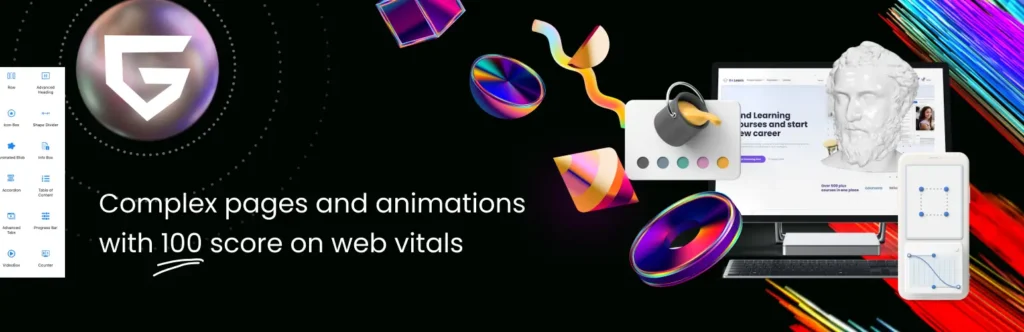
GreenShift is a performance-focused animation plugin built for the Gutenberg block editor. It lets you animate blocks with transformation, scroll, text, trigger, timing, stagger, parallax, and 3D effects.
One of its main strengths is conditional asset loading. Animation resources are loaded only on pages where they are needed. This can help reduce unnecessary front-end resources.
GreenShift also supports GSAP for more advanced animation work. It includes SVG animation features for drawing, path animation, and morphing. You can also control animations separately for different devices.
Here is a discussion of every GSAP animation HappyAddons includes.
4. DiviMotion (Best for Divi Animation Controls)
DiviMotion is built specifically for Divi and gives users GSAP-powered animation controls across Divi layouts. You can animate sections, rows, modules, and nested elements.
It supports transformation, scroll, text, trigger, timing, and staggered animations. It also includes advanced modules for DrawSVG, MorphSVG, Scramble Text, and Physics2D.
Other features include Horizontal Scroll, Card Stack, and Card Deck layouts. The plugin also includes pre-built animated templates to speed up the design process.
5. Motion.page (Best for Professional GSAP Timelines Across Any Builder)
Motion.page is a powerful option for users who want GSAP animation control without depending on a specific page builder. Instead of connecting directly to Elementor, Gutenberg, or another builder, it targets page elements using CSS selectors. This means you can use it with Elementor, Gutenberg, Oxygen, custom themes, and other WordPress setups.
Its visual timeline editor gives you detailed control over animation sequences. It is especially useful for page-load animations, exit animations, scroll effects, and complex multi-step timelines.
6. Blocks Animation (Best for Simple Free Gutenberg Animations)
Blocks Animation is a simple choice for Gutenberg users who mainly need entrance and basic motion effects. It has more than 90,000 active installations and works directly from the WordPress block settings.
The plugin uses CSS instead of GSAP. You can select a block, choose an animation, adjust timing and delay, and publish it without dealing with a separate animation interface.
Because it uses CSS, it has a low performance overhead. It is a good option for blogs and content-heavy websites that only need simple animations.
Check this discussion on if you can create interactive animations on WordPress like Webflow.
7. LottieFiles for WordPress (Best for Lottie Animations)
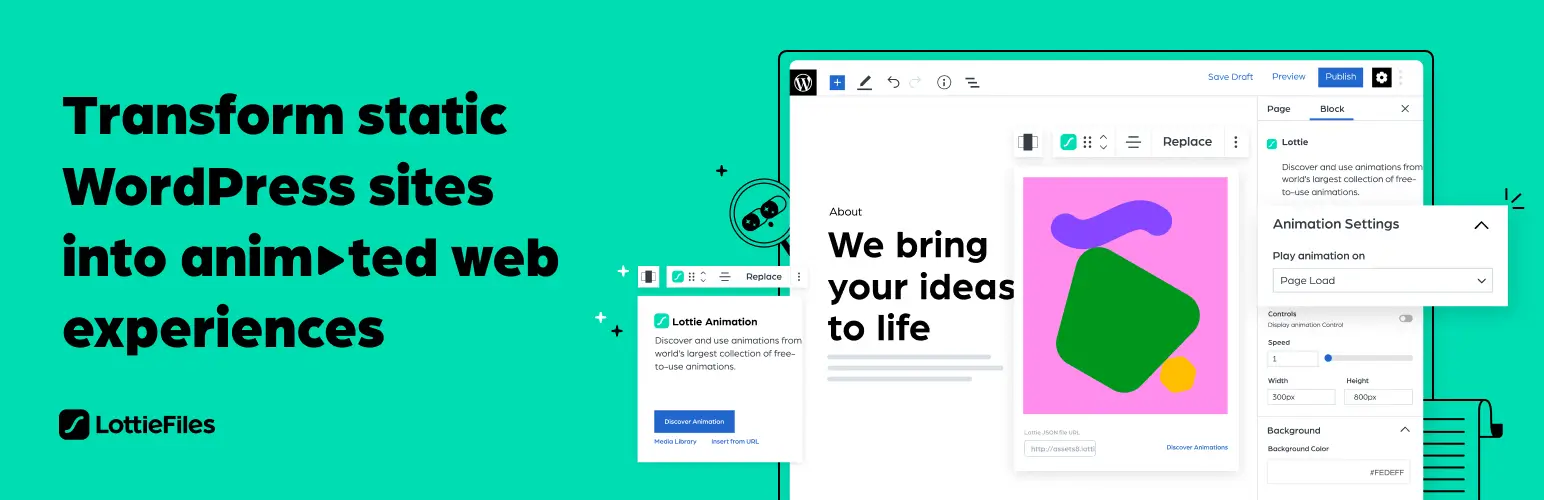
LottieFiles for WordPress is a good option if your main goal is to add Lottie animations to a WordPress website. Lottie animations are JSON-based animations that can scale to different screen sizes without losing quality. They work well for icons, illustrations, logos, loading animations, and other visual elements.
The plugin supports both .json and .lottie files. You can upload your own animation or use animations from the LottieFiles library.
8. Power Gloo (Best for Interactive Micro-Animations)
Power Gloo focuses more on interactive user experiences than large cinematic effects. It includes GSAP-powered extensions for mouse-follow effects, scroll-linked movement, slider animations, and other interactive behaviors.
It supports scroll-based, trigger-based, text, custom keyframe, and 3D animations. This makes it useful when you want small interactions that make a page feel more responsive.
9. UiCore Animate (Best for Animated Backgrounds)
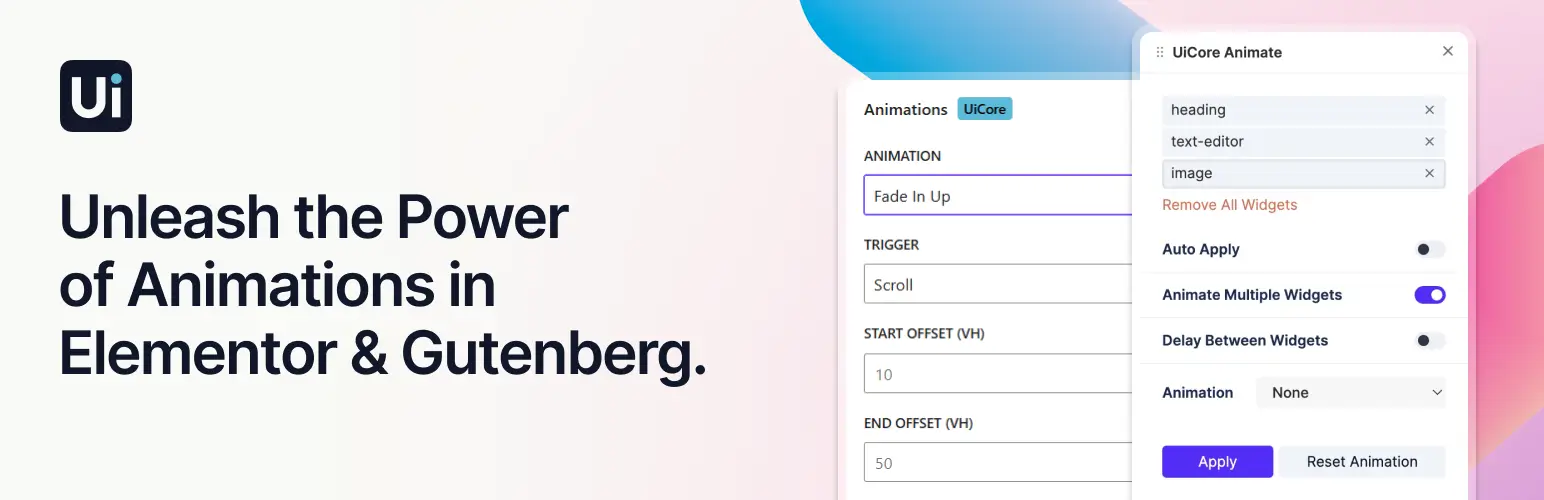
UiCore Animate takes a different approach. Instead of focusing mainly on element animations, it specializes in animated section backgrounds. It includes animated gradients, aurora effects, abstract shapes, glowing orbs, image distortion effects, animated borders, and several scroll effects.
It works with both Elementor and Gutenberg. The plugin is also very lightweight, making it a good choice when you want visual movement without adding a large animation system to your website.
Frequently Asked Questions on the Best WordPress Animation Plugins
Animation plugins can differ a lot in their features, performance, and page builder support. These common questions can help you understand which type of plugin is right for your website.

Is there a free GSAP animation plugin for WordPress?
Yes. HappyAddons offers a free tier with several GSAP elements. GreenShift also offers a free version with limited advanced animation features. But since GSAP is a complex animation library, it takes developers a lot of labour to develop it. So, the advanced elements of GSAP animations are usually reserved for pro users.
Can I use GSAP animations in Elementor without a plugin?
Yes, but you need to add custom JavaScript and configure the GSAP scripts correctly. You also need to make sure the code works properly with Elementor’s dynamic content and future updates. For most Elementor users, an animation plugin is a much easier way to use GSAP without maintaining custom code.
What is ScrollTrigger in a WordPress animation plugin?
ScrollTrigger is a GSAP feature that connects an animation to the user’s scroll position. It can start an animation when an element enters the viewport. It can also control the animation as the visitor scrolls.
Some plugins support scrubbing as well. With scrubbing, the animation progress follows the scrollbar. Scroll down, and the animation moves forward. Scroll back up, and it moves backwards.
Do WordPress animation plugins slow down my site?
They can, depending on how the plugin handles its assets and how many animations you use.
Plugins with conditional asset loading only load animation resources on pages where they are needed. This can help reduce unnecessary JavaScript and CSS. CSS-based animation plugins are usually lighter, while GSAP-based plugins offer more advanced effects.
Good optimization is important when using any animation plugin. Avoid adding heavy animations to every section of a page just because the plugin makes them easy to create.
Which WordPress animation plugin is best for landing pages?
It depends on the type of landing page you are building.
For Elementor landing pages with advanced GSAP effects, HappyAddons GSAP Pack and Animation Addons for Elementor are strong choices. If you need detailed GSAP timeline control across different page builders, Motion.page is a flexible option.
For simple entrance animations where keeping the page lightweight is the main goal, CSS Hero Animator or UiCore Animate may be enough.
Can I combine multiple animation plugins on one WordPress site?
Technically, yes. However, using multiple animation plugins is usually not a good idea.
Two animation plugins may load different versions or configurations of GSAP. This can sometimes lead to JavaScript conflicts or unexpected animation behavior. It is better to choose one main animation plugin and use it consistently throughout your website.
What is the difference between CSS and GSAP animation in WordPress?
CSS animations are built into the browser. They work well for simple effects such as fades, slides, zooms, and basic bounces. They are also lightweight and easy to use.
GSAP is a JavaScript animation library that provides much more control. It can handle scroll-triggered animations, timeline sequences, physics effects, SVG drawing, text splitting, shape morphing, and scrubbing.
If you only need basic entrance effects, CSS may be enough. If you want animations that respond to scrolling or create more complex interactions, a GSAP-based plugin is the better choice.
Final Takeaways!
Choosing the right WordPress animation plugin depends on what you want to create. Simple websites may only need CSS-based effects such as fades and slides. More interactive websites may need GSAP for scroll triggers, scrubbing, physics, SVG animations, and advanced timelines.
Your page builder, budget, performance needs, and required effects should guide your decision. For Elementor users, HappyAddons could be the best option if you wish for GSAP. For Divi, the DiviMotion plugin is ideal. And if you don’t want to be tied to any specific page builder, Motion.page is a strong option.
Animation should improve the experience, not distract from it. Start with the effects your website actually needs and choose a plugin that can deliver them without adding unnecessary complexity. With the right tool, you can turn a static WordPress page into a more engaging and interactive experience while keeping your design and performance goals in balance.
![Black Friday and Cyber Monday are around the corner, and people are waiting for these festivals to grab the best product deals. That is why giving an attractive look to your website during this festive season is very necessary. But, creating a whole new landing page might be difficult in a short period of time. Don't worry. By using Happy Elementor Addons Black Friday and Cyber Monday Landing Page templates, you can easily develop a whole new landing page in a few minutes. In this today's blog, we are going to show how to boost your website design using HappyAddons templates during this festival season. Before that, we'll talk a bit about these two festivals and why they are important to online business communities. What are Black Friday and Cyber Monday? Black Friday is the immediate following of the famous Thanksgiving day. This is when people start shopping to celebrate the Christmas festival. Since the late 1980s, retail sales on this day have constantly been suppressing the past volumes. See the graph below. Source: Salecycle.com The first Monday following Thanksgiving day each year is called Cyber Monday. It was first introduced in 2005 by the USA National Retail Federation to encourage people to buy online. Though this festival originated in the USA, it is celebrated globally today. See the stats below. Source: Salecycle.com It indicates customers' buying behavior around this day is growing up over time. Many customers today keep a budget to buy products on these two days. So, why won’t you prepare a Cyber Monday landing page if you have an online store? Importance of Designing Landing Pages for Black Friday and Cyber Monday Festival Having a well-design website is one of the major checklists if you are running an online business. Most importantly, you have to make sure that your website remains up-to-date to boost your sales. That is why you need to redesign your website or make a new landing page during the Black Friday and Cyber Monday festivals. Because most online product & service-based businesses promote special deals during these two festivals. Here are some remarkable ways dedicated landing pages during these festivals can positively impact the performance of your online business. Boosts your product salesIncreases conversion rateOpportunity to collect potential email leadsGrabs users' attention toward your siteReduces bounce rateIncreases website visitors. Elementor Black Friday New Seasonal Kit is Already Here! Source: Elementor To make this Black Friday more enjoyable, Elementor has launched a New Seasonal Kit that includes landing pages, sections, pop-ups, and vector assets. All these design elements are made by the Elementor team so that one can easily use them on their website to ensure more sales and conversions. New Elementor Black Friday Seasonal Kit offers: 3 Landing pages6 Sections 6 Popups A collection of stickers & animations You can only get these ready-made Black Friday landing pages and sections if you have Installed Elementor Pro on your site. However, if you are looking for templates that are outside of the box, you can go with Happy Addons, the fastest Elementor Addons on the market. It's very easy to use, flexible and has tons of advanced features and widgets that can ease your website design journey. Also, you'll get several festival landing page templates & blocks. Moreover, you can use free Black Friday and Cyber Monday design blocks and templates to decorate your site. Most importantly, these templates and blocks are easy to customize and can be used for multiple purposes. Now let's see how you can use the Happy Addons templates to design your website according to the Black Friday theme. Pre-Requisites to Use HappyAddons Templates to Design Black Friday and Cyber Monday Landing Pages You must have the following plugins installed on your site to get access to the HappyAddons Template library. Make sure you’ve installed and activated the Happy Addons Free & Premium version of your website. Elementor (Free)Happy Addons (Free)Happy Addons Pro If you are new to Elementor, check this Step By Step Guide For Beginners. If you want to explore the readymade templates of HappyAddons before installing these plugins, you may visit by clicking on the button below. Check out Happy Addons Templates How to Design Black Friday Landing Page on Your Website Once you have the plugins (mentioned above) installed, your website is ready to follow the tutorial guide explained in this section. Get ready now! Step 1: Open a New Page with Elementor Create a new page or open the existing page with Elementor. Next, you have to select the Elementor Canvas option.Unless you select Elementor Canvas, you may watch the header, footer, and unnecessary other texts on the page. These might be irritating to you.Once you open the page with Elementor Canvas, your page will be completely clean. Watch the video below on how to do it. Step 02: Go to HappyAddons Library Click on the HappyAddons Library Icon. It will open up a modal popup. Here you'll find numerous stunning premade Blocks and Pages created by the Happy Addons team. Kindly explore them to create a list of your favorite items. Step 03: Import a HappyAddons Black Friday Template Go to the Page tab on the modal popup.Select Black Friday from the left-side filter option.You will several good-looking templates on your screen.Take your cursor on the one you like and hit on the INSERT button. Wait for a while to finish the installation process. You will get the template on your screen with editable sections and options. Step 04: Set the Black Friday Campaign Deadline A deadline creates a sense of urgency in customers' minds. So, better if you add a deadline section on the page to show your Black Friday deals. The good thing is that if you select the template as we did, you will automatically get a deadline or countdown option. You have to customize it as you want. Step 05: Show Image Carousel Slider on Your Black Friday Landing Page Using the Image Carousel, you can slide show demonstrating discounts on your product categories. Drag and drop the Image Carousel widget on any landing page section. Next, from the Elementor panel, you can add photos and text to the widget. Do it accordingly. Thus, you can add more sections and options on the landing page. Hope you can do it yourself. Step 06: Make the Black Friday Landing Page Mobile Responsive Making a web page mobile responsive with Elementor is super easy. You'll get the mobile responsive option on the Elementor footer section. Clicking on it will open up the option to view your landing page on different device screens. We have explained the process in the video below. Note: Don't delete any widget or section while customizing your landing page for any particular device. Because if you delete a widget or section on any device screen, it will also be applied on other devices. However, you may change their position or alignment or hide them. It won't make any impact on other devices. Step 07: Final Preview of Our Landing Page Here is the final interface of our Elementor Black Friday landing page that we've designed using the Happy Addons' ready-made Template. Get Happy Addons to Add a Black Friday Theme Landing Page on Your Website How to Design Cyber Monday Landing Page on Your Website You will require the same prerequisites (Elementor and HappyAddons Plugins) to design the Cyber Monday landing page on your website. Hope you have them ready on your website. Now, let's get into the tutorial part. Step 01: Import a Cyber Monday Readymade Landing Page Template Go to the HappyAddons Template library.Choose the Cyber Monday template you like.Click on the INSERT button. Wait for a while to finish the installation process. You'll get a page design like the following image below. Step 02: Edit Different Sections of the Page In the first tutorial, you saw the deadline/countdown option was already embedded in the template. But this template doesn't have it. So, you can bring it to your page? Very simple. Create a new section by clicking on the plus icon.Type Countdown on the Elementor search bar.Drag and drop the widget on the section. Customize the Countdown section from the Content and Style tabs of the Elementor panel. Using the Heading widget, we have added the FLASH DEALS text next to the countdown to make it more meaningful. Thus, you can use other exciting widgets on the template to make your landing page super gorgeous. Step 03: Promote Products on the Landing Page Promotional landing pages usually include a section to showcase some hot-selling products to generate instant sales. Using the Image and Button widgets, we have created this section under the FLASH DEALS.You may customize it more as you wish. Step 04: Make it Mobile Responsive We already showed you the process in the first tutorial on making a mobile web landing page responsive. Hope you can do it here as well, following the same guideline. Click on the Responsive Mode icon and do the rest yourself. Bonus: Black Friday and Cyber Monday Landing Page Design Key Considerations Whenever you design a landing page, you need to consider why you need to design this page and what elements they should keep on the page. Because if you are not adding all the necessary features to your page, it will not serve its purpose. This is why you need to focus on a few things before designing your Black Friday landing page. Here are some points you must consider in designing Black Friday and Cyber Monday landing pages. Add Black Friday textSet deals deadlineShow your best-discounted productsAdd coupon code Focus on responsive page designMake your page visually appealingImprove your page user experience or page structureSet a proper website navigation FAQ on Black Friday and Cyber Monday Landing Page Design Now, we'll answer some common questions on Black Friday and Cyber Monday Landing page designs commonly found online. How much does it cost to design a landing page?The cost of designing a landing page varies depending on the complexity of the design, the level of customization required, and whom to hire for the page. A simple landing page can be designed for as little as $25, while a more complex design with multiple customizations can cost upwards of $2,00.However, if you have Elementor and HappyAddons installed, you can design unlimited landing pages at a minimal cost. But like any other tool, you must have a kind of enterprise on them. As they are drag-and-drop builders and their numerous tutorials and documentation are available, they won't take you more than a month to be used to. Check out some wonderful YouTube tutorials on these two plugins. Hope you will enjoy them.How many hours does it take to design a landing page?It mainly depends on the level of design complexity and your web design skill. However, both in Elementor and HappyAddons, you will get countless readymade templates and block sections. You can design a beautiful landing page in 3-5 hours by making a proper combination of them.Can I design Black Friday and Cyber Monday Landing pages with Elementor and HappyAddons free versions?Surely, you can design Black Friday and Cyber Monday Landing pages with Elementor and HappyAddons free versions. But only with the pro versions, you can't add too many exciting features to your pages. For example, free versions will give you access to only a limited number of readymade templates.If you are just a beginner-level designer, free versions are enough. But if you are a professional designer or have a web designing agency, pro versions are a must. Are You Ready To Design Your Black Friday and Cyber Monday Landing Page? Customers look forward to this kind of occasion to buy their favorite products at a minimum price. Naturally, they are drawn to websites that look good and give a festive vibe. That is why adding a Black Friday and Cyber Monday landing page during the festival season will give you an extra edge over the competitors. The above guide shows how to design your Elementor Black Friday Landing page using the Happy Addons' Black Friday Templates and how it can help boost your holiday sales. So if you have any queries regarding this blog, you can comment on us in the below box. If you like this post, then share it on your social channel. Don't forget to subscribe to our newsletter. Also, follow our Facebook and Twitter channels for regular updates. Subscribe to our newsletter Get latest news & updates on Elementor [yikes-mailchimp form="1"] ":36560} /--](https://happyaddons.com/wp-content/uploads/2021/11/How-to-Design-Black-Friday-and-Cyber-Monday-Landing-Page-300x188.png)